Beyond the Static Screen:
Your website is not a brochure. Your social media is not a megaphone. And your PR strategy is not a press release factory.
Yet here we are in 2026, and far too many SMEs and corporate brands are still treating their digital presence like a glorified shop window: static, one-dimensional, and about as engaging as a beige wallpaper catalogue. Meanwhile, your competition is building something far more powerful: a hypermedia brand ecosystem that doesn't just speak at audiences, but converses, adapts, and performs across every single touchpoint.
Welcome to the era of hypermedia branding. If you're still thinking about your website, PR strategy, and social channels as separate entities, you're already behind.
What Is Hypermedia Branding?
Let's be clear: hypermedia branding isn't just a buzzword we've conjured up to sound clever at networking events. It's a fundamental shift in how modern brands operate.
Traditional branding lived in silos. Your PR team handled media relations. Your web developer built you a website (and disappeared). Your social media manager posted content. Your graphic designer made things look pretty. Everyone worked in their own lane, occasionally waving at each other across the metaphorical motorway.
Hypermedia branding destroys those silos entirely.
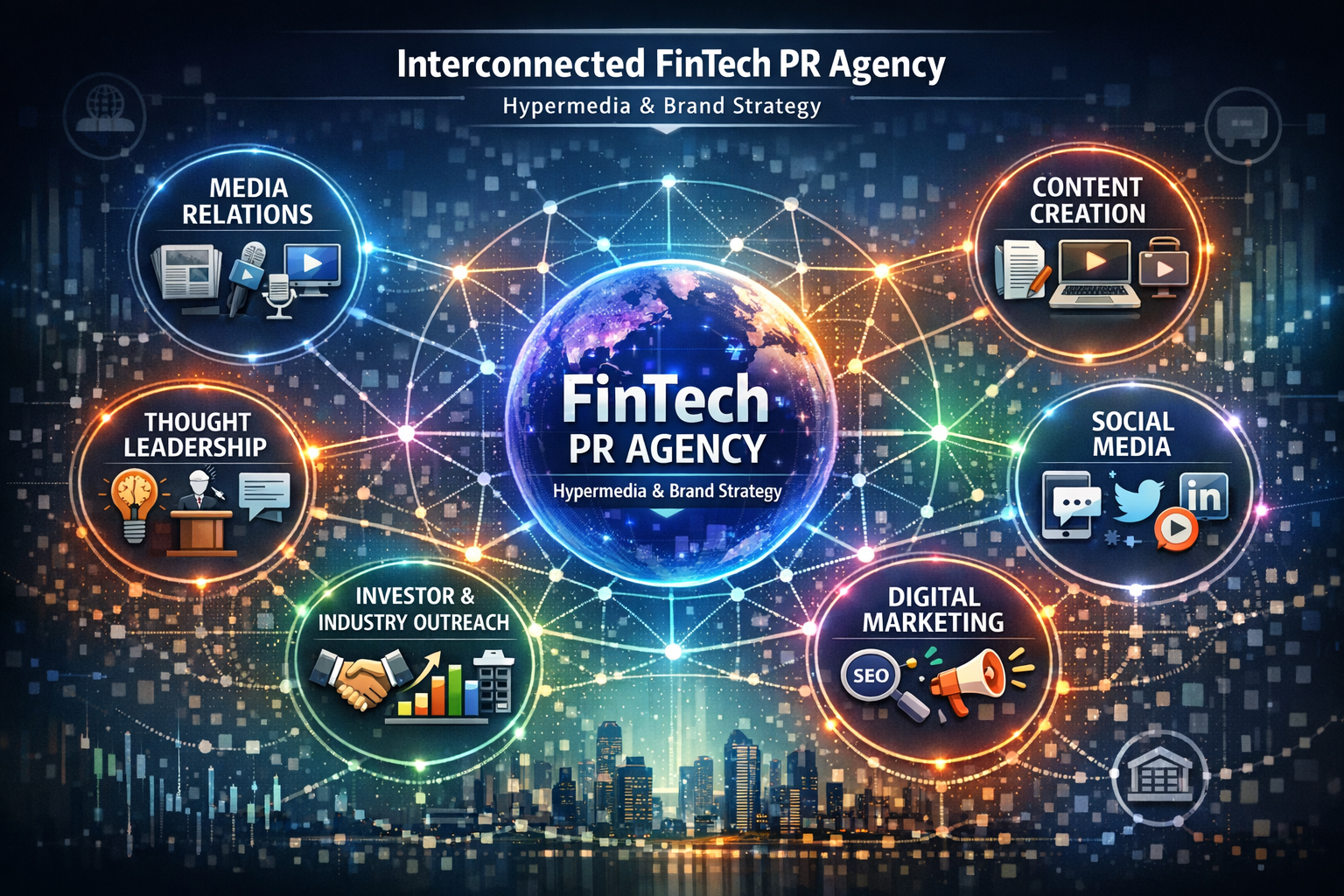
It's an integrated approach where every element of your brand: from your website's infrastructure to your press strategy, from your social media tone to your performance metrics: exists as interconnected nodes in a single, dynamic ecosystem. Your website isn't just a destination; it's a living, breathing platform that responds to PR campaigns, feeds data to your content strategy, and evolves based on audience behaviour. Your PR isn't just about getting coverage; it's about creating narratives that ripple across web, social, and owned channels simultaneously.
Think of it this way: a traditional brand is a photograph. A hypermedia brand is a film with interactive subtitles, behind-the-scenes footage, and a choose-your-own-adventure structure. Which one would you rather experience?
The Death of the Static Website
Here's an uncomfortable truth: that website you commissioned three years ago is now little more than an expensive business card.
It sits there. It looks presentable enough. Perhaps it even won a design award. But what is it doing for your business? Is it generating leads? Is it telling your story in real-time? Is it integrated with your PR campaigns so that when you secure coverage in the Financial Times, your website automatically updates to showcase that credibility?
Probably not.
The old model treated websites as finite projects with a beginning, middle, and end. You'd brief an agency, they'd build you something, you'd launch it with fanfare, and then... nothing. It would languish, gathering digital dust, while your brand evolved elsewhere.
An integrated PR agency that understands hypermedia branding approaches this entirely differently. Your website becomes a dynamic hub: a nerve centre that coordinates with every other aspect of your brand presence. When your PR team secures a partnership announcement, your website adapts. When your social media identifies a trending conversation, your web content responds. When your performance data reveals what your audience actually cares about, your entire digital ecosystem adjusts accordingly.
This is what separates functional business tools from glorified shop windows. The latter exists to be admired. The former exists to perform.
Why 2026 Demands Hypermedia Thinking
The digital landscape has fundamentally changed. We're living in what many are calling the "post-AI" era, where generative engines, algorithm shifts, and audience expectations have evolved beyond recognition.
Consider these realities:
- Search is no longer search. Google's algorithms now prioritise Generative Engine Optimisation (GEO) over traditional SEO. Your audience isn't just typing queries; they're having conversations with AI assistants who curate answers from across the web. If your brand exists in isolated pockets: a static website here, some social posts there, occasional press coverage somewhere else: you're invisible to these systems.
- Attention is fragmented. Your customers aren't on one platform; they're everywhere simultaneously. They might discover you on TikTok, research you on LinkedIn, verify you through press coverage, and convert on your website: all within the same hour. If these touchpoints don't speak the same language and reinforce the same narrative, you've lost them.
- Authenticity is auditable. In an age of deepfakes and AI-generated content, audiences have developed a sixth sense for inconsistency. A hypermedia brand maintains narrative coherence across every channel because everything is connected. There's no opportunity for your PR messaging to contradict your website copy, or for your social presence to feel disconnected from your corporate identity.
This isn't just theory. We've seen it play out across industries. The brands thriving in 2026 are those that embraced hypermedia thinking early: companies that stopped treating their digital presence as a collection of separate parts and started building integrated ecosystems.
How Integrated PR Delivers Hypermedia Branding
So what does this look like in practice?
An integrated PR agency worth its salt doesn't just write press releases and hope for the best. We architect entire brand narratives that exist simultaneously across multiple dimensions.
Let's take artist branding as an example, since the principles apply beautifully to corporate brands as well. When we work with musicians, we're not just securing them press coverage. We're building a hypermedia ecosystem where:
- Their website dynamically showcases recent press mentions, upcoming performances, and fan engagement metrics
- Their social channels amplify PR wins whilst maintaining authentic voice and community interaction
- Their press strategy feeds into content marketing, which feeds into web development priorities, which feeds into data collection
- Every element is tracked, measured, and optimised based on performance data
The same principles apply whether you're a fintech startup, a law firm, or a manufacturing business. The question isn't what industry you're in; it's whether you're treating your brand as a static entity or a dynamic ecosystem.
This is what we mean by performance branding. Your brand isn't just an identity; it's a system that performs measurable functions. And the integration is what makes it powerful.
The Technical Reality
Let's address the elephant in the room: this sounds complicated.
It is. Not because the individual components are impossibly complex, but because true integration requires expertise across multiple disciplines. You need strategists who understand narrative architecture. Developers who can build responsive, data-driven platforms. PR professionals who think beyond media lists. Content specialists who can maintain voice across channels. Analysts who can identify what's working and what isn't.
This is precisely why the "hire separate freelancers for each bit" approach fails. Hypermedia branding demands coordination, shared vision, and seamless execution. It requires everyone to be working from the same playbook, speaking the same language, and understanding how their work connects to the larger ecosystem.
When we describe ourselves as a Public Relations & Branding agency, we're really describing a much broader capability: building integrated brand ecosystems for clients who refuse to settle for mediocrity. Music just happens to be one of the most demanding proving grounds for these principles.
Stop Building. Start Integrating.
Here's the shift in mindset we need: stop thinking about building individual assets and start thinking about growing integrated systems.
You don't need a new website, a PR campaign, and a social media strategy. You need a hypermedia brand ecosystem where all three exist as interconnected elements of a larger whole.
You don't need separate agencies handling different bits. You need an integrated approach where strategy, execution, and performance measurement happen in harmony.
You don't need more content. You need smarter integration of the content you're already creating.
The future of branding isn't about doing more; it's about connecting what you're doing in ways that multiply impact rather than dilute it.
The Question You Should Be Asking
The question isn't whether hypermedia branding is right for your business. The question is whether you can afford to ignore it whilst your competition figures it out first.
Every day you operate with a siloed digital presence is a day you're haemorrhaging opportunity. Every campaign you run without integration is diluted by a factor you'll never even measure. Every pound you spend on disconnected tactics is a pound that could have generated exponential returns through strategic coordination.
The brands that will dominate the next decade are being built right now. They're not the ones with the biggest budgets or the flashiest campaigns. They're the ones with the most integrated, responsive, and intelligent brand ecosystems.
Which side of that divide do you want to be on?
BOOK NOW FOR YOUR FREE STRATEGY CALL!